Showing posts with label Equiano. Show all posts

Thursday, December 15, 2011

Concerning the Importance of Public Opinion

Introduction

Our identity as well as justification for a lot of our actions come from other people’s perceptions of us. Adam Smith articulated this very well in his 1759 piece “The Impartial Spectator” from the book The Theory of Moral Sentiments. In this piece, Smith argues that a large part of our identity – how we consider our actions as being right or wrong – come from other people’s perceptions of us. The way we think about ourselves has a lot to do with the way others think of us. [1] Molly Jaffe points out in her post “Were Mirrors Less Shiny in 1759?” the interesting implications of this way of thinking in today’s world of social media. [2] But more relevant to this class is how this way of thinking – of placing so much importance in defining oneself and ones position in society based on other people’s opinions – influenced many aspects of society in the eighteenth century. The careful maintenance of a public image may not have been as visible in the eighteenth century because the internet hadn’t been invented yet, but it was nevertheless very important both in terms of societal expectations and behaviors, and in the way that authors like Benjamin Franklin and Olaudah Equiano communicated ideas in their writing.


Societal Expectations and Behaviors


Two of Franklin’s works – “Advice to a Young Tradesman, Written by an Old One” and “Rules to be Observed in Trade” – show one way that public perception was important to society: credit. In these pieces, Franklin discusses the fairly new (at the time) concept of credit and explains some good methods to use credit without negative financial consequences. Of course, there is a lot of practical financial advice contained in these two articles, written in Franklin’s classic witty and memorable style: “Remember that CREDIT is money,” is one of the more memorable quotes towards the beginning of “Advice to a Young Tradesman”. [3] But Franklin goes on to describe something that he sees as even more important than the business side of credit. Scott singer sums it up very well in his post “Credit of Two Sorts”: “having good financial credit and having good credit as a man are inextricably linked.” [4] In addition to all the obvious advice relating to the technical workings of credit, Franklin advises that a good reputation is just as important as actually paying back your creditors. “Strive to maintain a fair character in the world: That will be the best means for advancing your credit.” [5] If your creditors think that you are lazy, they will be more likely to try to collect their payments before you are able to pay them, whereas if you keep up the appearance of an industrious worker your creditors will be more likely to give you more time because they will be confident that you will be able to pay them back eventually. This is a very important application of the necessity of constructing one’s public image carefully in order to function within the credit-driven society of the eighteenth century.

It was also very important for women to watch closely what other people thought of them in the eighteenth century, due to now-archaic gender roles which were common at the time. Jean-Jacques Rousseau was a staunch advocate of these traditional roles, and describes an aspect of these roles that almost seems to place a woman’s reputation above her actual actions. In “Duties of Women,” Rousseau states: Worth alone will not suffice, a woman must be thought worthy; nor beauty, she must be admired; nor virtue, she must be respected. A woman’s honor does not depend on her conduct alone, but on her reputation, and no woman who permits herself to be considered vile is really virtuous.” [6] A man, on the other hand, “has no one but himself to consider, and so long as he does right he may defy public opinion.” [6] Vann Bentley touches on the double standards inherent in these gender standards as he discusses the flaws in Rousseau’s logic in his post “Rousseau’s Unenlightened Thought Process”. The reality of the eighteenth century for women, though, required them to be very careful in their public conduct so that their reputations stayed clean.


Benjamin Franklin


In addition to being important in social and economic interactions, the idea of a carefully constructed public reputation greatly influenced the writing styles of Benjamin Franklin, Olaudah Equiano, and probably many others.

Franklin clearly thought a lot about the face he showed to the world when he was writing, so much so that he often created personas to make his arguments more powerful. For example, the very first works that he ever published, the Silence Dogood letters, were published under the pseudonym of Silence Dogood. It is very significant that Franklin used this name rather than his own because he was only a teenager at the time, and his opinions would not be taken seriously if he were to publish the letters under his own name. Ben recognized that his own public image was insufficient because of his age and created a new public image for himself for the sake of the letters.

Franklin fleshed out his persona to be a middle-aged widow writing to The New England Courant about various social issues of the day. He went to great pains to give this made-up woman an entire life story: she was orphaned at a young age and raised by a “pious good-natured” country minister who made sure she was “instructed in all that Knowledge and Learning which is necessary for our Sex.” [8] With this description, Franklin is constructing a public image of Silence as a traditional woman (thus she is not threatening to any male readers) who is nevertheless well-educated (thus her opinions can be taken seriously).

The female persona Franklin constructed for himself worked especially well in Silence Dogood, No. 5, where he wrote about women’s rights. BF’sMainSqueeze discussed this letter in her post “Silence Dogood – Defender of the Fair Sex”. In this letter, Franklin/Dogood “valiantly defends women” [9] by pointing out that men have the same flaws as women (and often to a greater degree). He also talks about women’s education and blames men for any ignorance that women have: “I have … often thought of it as one of the most barbarous Customs in the World, considering us a civiliz’d and Christian Country, that we deny the Advantages of Learning to Women,” he writes. [10] Coming from a teenage boy, this letter would have been ridiculed, but coming from a well-educated middle-aged widow the piece is taken seriously and works very well as a social commentary. Thus Franklin created another public image for himself when his own wouldn’t do, and it was very successful.

In a less extreme way, Franklin also manipulated his public image in his autobiography. He did not create an entirely new persona for himself in this book; rather his manipulation lies in what he chose to write about his life. He could have shown all of the dirty details of his life, every flaw and every mistake he had ever made. Instead, Franklin portrayed himself as an industrious, honest, hard-working individual who pulled himself out of the lower class through perseverance and self-education. Rarely does Franklin let us see any weaknesses; instead the book is full of stories of how hard work pays off and how frugality can help advance the situation of anyone willing to make a few sacrifices.

This characterization of himself – this manipulation of the reader’s perception of him – is very deliberate, and the reason for the construction of his public character in the way that he did can be found in one of the letters included in this edition of the autobiography. Abel James is writing to Franklin telling him his thoughts on the manuscript for the first part of the autobiography, and says the following: I know of no Character living nor many of them put together, who has so much in his Power as Thyself to promote a greater Spirit of Industry and early Attention to Business, Frugality and Temperance with the American Youth.” [11] Franklin constructed this outward representation of himself in order to create an image that would be useful in teaching future generations to live virtuously and successfully.


Equiano


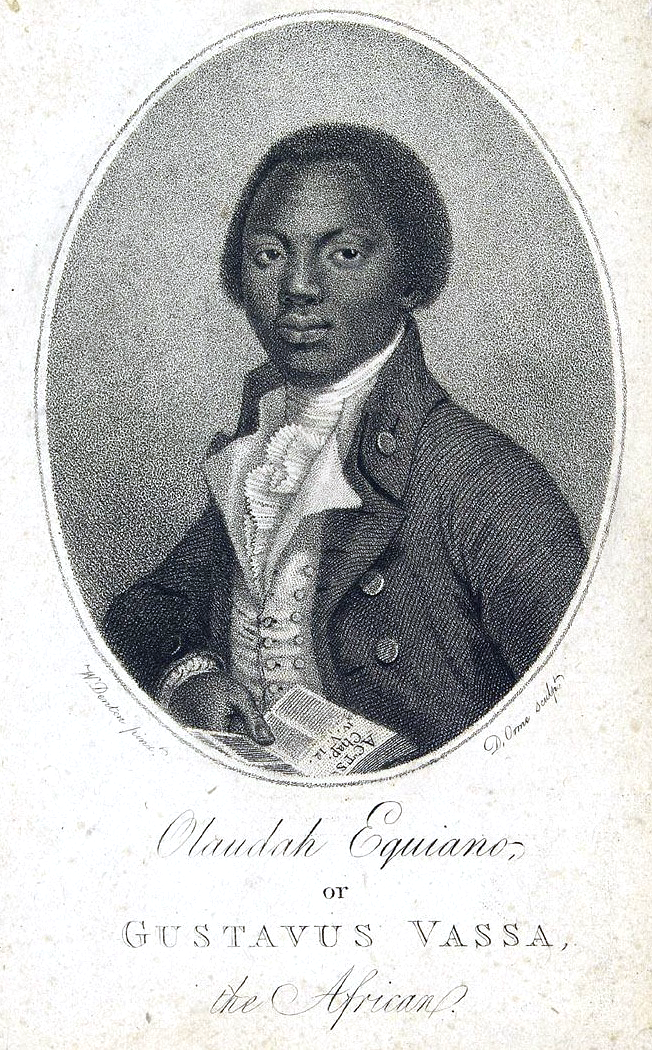
Olaudah Equiano similarly manipulates the public opinion of himself in his own autobiography, but for very different reasons and for a much different effect. In Equiano’s Interesting Narrative, he goes to great pains to develop an image for himself as like a European. One way that he does this is through his portrayal of his religion. As Molly Jaffe discusses in her post “Saint Equiano”, Equiano does not describe himself as ever being angry at his white masters, going so far as to blame himself when his master unfairly sells him instead of giving him his freedom, claiming that this turn of events was God punishing him for some insignificant wring he had done. “He seems to be building up the persona of a “noble savage” and only occasionally addresses the anger felt by the slaves towards the tyranny they are subjected to… His novel is not written to inflame his white readership with accusations, but rather to ignite feelings of sympathy and shame within their hearts.” [12] The image that Equiano crafts for himself throughout the narrative is carefully calculated to give his European readers an impression of him as a God-fearing, Europe-loving, peaceful man, because he wants his them to listen to his arguments against slavery as coming from a rational and non-threatening person.


Conclusion


Consciousness of public opinion was very important in the eighteenth century as it shaped aspects of society including gender roles and credit etiquette, and skillful manipulation of the public image was used as a successful writing technique by Franklin and Equiano.


Works Cited

[1] Smith, Adam. "The Impartial Spectator." The Portable Enlightenment Reader. Ed. Isaac Kramnick. New York: Penguin Group, 1995. 280-287. Print.

[2] Jaffe, Molly. "Were Mirrors Less Shiny in 1759?" English 274: Benjamin Franklin and the Age of Enlightenment. Vanderbilt University, 7 Sept. 2011. Web. 14 Dec. 2011.

[3] Franklin, Benjamin. “Advice to a Young Tradesman, Written by an Old One.” Philadelphia: 1748. PDF file.

[4] Singer, Scott. "Credit of Two Sorts" English 274: Benjamin Franklin and the Age of Enlightenment. Vanderbilt University, 22 Sept. 2011. Web. 14 Dec. 2011.

[5] Franklin, Benjamin. "Rules Proper to be Observed in Trade." Pennsylvania Gazette (Feb. 1749/50): PDF file.

[6] Rousseau, Jean-Jacques. “Duties of Women.” The Portable Enlightenment Reader. Ed. Isaac Kramnick. New York: Penguin Group, 1995. 568-579. Print. 575

[7] Bentley, Vann. "Rousseau’s Unenlightened Thought Process" English 274: Benjamin Franklin and the Age of Enlightenment. Vanderbilt University, 14 Sept. 2011. Web. 14 Dec. 2011.

[8] Franklin, Benjamin. "Silence Dogood, No. 1." The New England Courant (May 1722): PDF file.

[9] BF’sMainSqueeze. "Silence Dogood – Defender of the Fair Sex" English 274: Benjamin Franklin and the Age of Enlightenment. Vanderbilt University, 12 Sept. 2011. Web. 14 Dec. 2011.

[10] Franklin, Benjamin. "Silence Dogood, No. 5." The New England Courant (May 1722): PDF file.

[11] Franklin, Benjamin. The Autobiography of Benjamin Franklin 2nd ed. Edited by Edmund S Morgan. New Haven, Connecticut:, Yale University Press. New Haven Connecticut, 1964. 134

[12] Jaffe, Molly. "Saint Equiano." English 274: Benjamin Franklin and the Age of Enlightenment. Vanderbilt University, 1 Dec. 2011. Web. 14 Dec. 2011.

[13]Equiano, Olaudah. The Interesting Narrative and Other Writings. 1789. New York: Penguin, 2003. Print.

Wednesday, December 14, 2011

The Vehicle of Enlightenment

Introduction

Certainly, a flood of scientific discoveries emerged from the Enlightenment, but what truly distinguishes this era is the manner in which these ideas entered society. After all, it is unlikely that loads more intelligent people were simply born after the dark ages, so why did Franklin’s lightning experiment draw widespread consideration from the public, while Galileo’s earlier theory of heliocentrism evoked quite the opposite reaction? Granted, Franklin faced less oppression from the church, but more importantly, those around him had embraced the process of reason. Thus, if properly argued, even radical ideas could illicit serious attention. In his text on Franklin and the Enlightenment, Frank Kelleter explains how this new value allowed all sorts of ideas to emerge, regardless of prior conceptions:


Whatever ideological stance it took, enlightened reason always regarded itself as a critical faculty […] because it attempted to free human understanding from dóxa or opinion. […] Hence, to exercise one’s reason in an enlightened manner did not simply mean to speak the truth; it meant to eliminate a falsely established belief […] and act against all authorities that had an interest in perpetuating falsehood.[1]

Kelleter expresses how reverence for reason now made it possible to express contrary ideas because to oppress them would make the oppressor seem unable to stand up to the test of reason and interested in ‘perpetuating falsehood.’ For this reason, scientific and political debate flourished unlike darker times. The satire of the Royal Academy with ridiculous, abstract, useless science in Part III of Jonathan Swift’s Gulliver’s Travels, however, suggests that progress during the Enlightenment required the engagement of the whole populace, not just intellects.[2] Hence, the art of persuasion became as important as the reasoning itself to unite people in the cause and create progress. Authors tailored tactics such as pseudonyms, tone, and fiction to make a topic accessible to wide, targeted audiences. Consequently, even common laborers took a stance and aided in the progress of the enlightenment if an author could make it relate to them. Carefully constructed authorship served as the essential means to deliver reason during the enlightenment by forcing people to confront their complicity in issues.

Benjamin Franklin

His extensive writings, their varied forms, and the degree to which they shot him to prominence make Ben Franklin a prime example of the maneuverable authorship that reaches the masses. Of the many roles that Franklin pioneered, becoming America’s first feminist would have been one of the more difficult, as it involved fighting for a cause that had little existing support, particularly in print.[3] “The Speech of Miss Polly Baker” demonstrates how Franklin overcomes this challenge of universal opposition. First and foremost, Franklin understands his audience and assumes a female pseudonym to separate himself from his male identity. With the existing institutions affording all the power to men, male readers would likely feel resentment toward a male speaker, and women would find it difficult to believe that the speaker truly understood their needs.

Franklin also makes his audience receptive to his argument with use of a narrative, albeit a carefully constructed fiction to suit his needs. As a post by El Leon suggests, “rather than just giv[ing] his argument in philosophical terms, he uses a story that people can relate to, and tries to guide them in the story to the point where they should end.”[4] Franklin makes his article relatable by using several facts that readers would be aware of before he makes any appeal for change. He guides readers ‘to the point where they should end’ by putting the facts in an order that creates a logical progression to that point, making his suggestion seem not very outlandish. Moreover, he frames his suggestion as beneficial to his readership. As Molly suggests in her post “Financial Fears and Sexist Laws”, Franklin appeals to the economic benefits of changing the situation.[5] Another post proposes that Franklin argues that the laws make “natural actions” into crimes.[6] In either case, Franklin uses his audience’s existing beliefs and facts against them to make his case more digestible, rather than proposing something completely shocking, as female equality would have been. For example:


Twice I have paid heavy Fines, and twice have been brought to public Punishment, for want of Money to pay those Fines.

[…]

Laws are sometimes unreasonable in themselves, and therefore repealed

[…]

[I] could have done it better, if it had not been for the heavy Charges and Fines I have paid.

[…]

because I have had Children without being Married […] they have miss’d a Wedding Fee

[…]

do not turn natural and useful Actions into Crimes, by your Prohibitions.[7]

Franklin carefully chooses the facts that he uses to set up his logical argument. In progression, they state that the current laws do not work, they are amendable, and they currently inhibit ‘natural duties’ of women. Moreover, by placing the blame entirely on women, who cannot pay the fines anyway, the state loses money that it could make in marriage fees if men were held accountable. Consequently, Franklin can masterfully suggest the repeal of the current laws.

With the set-up of “The Speech of Miss Polly Baker”, Franklin’s solution does not sound extreme and actually pleases both men and women. Men would value the reinforcement of economics and the ‘natural’ role of women as mothers. Women, meanwhile, would be free of a particular burden but also given a solid argument that moves in the direction of feminism. Also, in more general terms, as Scott points out, “for the first time, it seems, the Enlightenment is giving […] a powerful, influential voice to the common man” (or woman in this case).[8] To top it off, Franklin even makes the status-quo laughable when Polly suggests that the judge should marry her if he wants a viable solution within the current framework. Franklin’s method of argumentation is quite smooth and disarming: “Franklin was a rare sage—a philosopher who wasn’t preachy. […] he served up folksy wisdom in the guise of a comic gent.”[9] This rare skill of combining reason and persuasion took Franklin far; it is why we study him today, and in addition to intelligence it is the skill that distinguished the visionaries of the enlightenment from the populace that followed (effectuating the progress).

“Polly Baker” particularly exemplifies Franklin’s rhetorical strategy, but his ‘non-preachy’ delivery and malleability to his audience permeates all his works that we have read this semester. Even his single-sentence maxims in “Advice to a Young Tradesman, Written by and Old One” embody this style.[10] They seem economical to the common man, yet phrased in a memorable way so as to not be condescending. Of this work, Alex writes: “while the message is an extremely vital one for the self-education of the population and the progress of society as a whole, it would not be communicated as effectively in another tone.”[11] Franklin chooses the appropriate tone again in “Idea of the English School” by loading the article with specific facts and a detailed plan to avert attention away from the fact that he never experienced such a formal education himself.[12] Thus, his stylistic choice affords him increased authority on the topic, as does his female pseudonym in “Polly Baker”. Molly’s post sums it up best: “the different characters Franklin assumes over the course […] illustrate how adept the man was in the art of persuasion. Franklin is hyper-aware of his readership, and never fails to tailor his persona to their expectations.”[13]

Equiano

Olaudah Equiano also demonstrates a hyper-awareness of his English readers. Like Franklin in “Polly Baker”, he understands that his narrative breaches on something that has not seen much publication—“perhaps the first account of [the middle passage] from the perspective of a slave, written in the English language.”[14] Equiano prefaces his Interesting Narrative with several letters that attempt to prove the authenticity of his autobiography. It seems he could not have lived more appropriate experiences, as a slave, African, and Englishman, to become a definitive voice against slavery—almost too ideal to be true. However, whether he constructs or relates his account, Equiano understands the manner in which his personal life colors his political suggestions for readers. Though his extraordinary life journey as a slave intuitively seems to qualify him to speak against slavery, Equiano instead establishes his authority on the subject by working to convince his readers that he represents British interests.

Equiano frequently likens himself to the British as a principle means to make it seem less like he acts out of an African interest. In his personal moments, this kinship often takes the form of adoration or longing for British culture: “I had often observed, that when her mother washed her face it looked very rosy; but when she washed mine it did not look so; I therefore tried oftentimes myself if I could not by washing make my face of the same colour as my little play-mate (Mary), but it was all in vain; and I now began to be mortified at the difference in our complexions.”[15] This episode subtly wins over Equiano’s British audience by showing them as so superior in his regard that he would alter the appearance of his body, if he could, to more closely resemble them. Not only does Equiano take a liking to the British, but also in some ways, he demotes his origins: “I was now amongst a people who had not their faces scarred, like some of the African nations where I had been. I was very glad I did not let them ornament me in that manner when I was with them.”[16] This rejection of his old culture to belong in British society would appear as a favorable conversion to Equiano’s English audience. Furthermore, as Molly posted, “his novel is not written to inflame his white readership with accusations, but rather to ignite feelings of sympathy and shame within their hearts.”[17] Equiano likely understands that the British would find it easier to feel sympathy toward his often-tragic experiences if they saw him as similar to themselves. By explaining the similarity of his culture with theirs, Equiano deconstructs the dehumanized view of slaves that British readers might hold.

As part of Equiano’s cultural change, he adopts Christianity and integrates it into many episodes of his narrative to better relate his accounts to a European readership. In many of his political statements, Equiano does not argue for the abolition of slavery, but rather the improvement of its conditions. He describes some of its horrors: “This Christian master immediately pinned the wretch down to the ground at each wrist and ankle, and then took some sticks of sealing-wax, and lighted them, and dropped it all over his back.”[18] The choice of describing the master as Christian attributes the inspiration of this punishment to the crucifixion of Christ. However, it actually marks the slave as more Christian than the master by making him a martyr like Jesus and revealing the master as not ‘doing unto others as he would have them do unto him.’ Just as Equiano claims he has improved by discovering Christianity, he suggests that the practice of slavery could improve by becoming more Christian. Like Franklin, he uses the existing beliefs of his audience to make his argument.

In suggesting changes to slavery, Equiano has to justify his claims in a way that would please Europeans. He does so by appealing to their benevolent side when he describes his mostly ‘kind’ masters: “This woman behaved to me with great kindness and attention; and taught me every thing in the same manner as she did her own child, and indeed in every respect treated me as such.”[19] This personal experience shows that not all British agree with treating slaves cruelly, that Equiano’s desire for reform would not necessarily be unwelcome, and that the relationship between slaves and masters need not involve fear and hostility. Under these conditions, Equiano shows how differently he thinks of his master: “I cried immediately, and said I would not leave him.”[20] Such a (relatively) positive master-slave relationship colors Equiano’s desire to change British slave practices as a genuine desire to help the society he has come to appreciate.

Having outlined his intentions as noble to the British, Equiano has gained the attention of this audience. He then makes arguments of reform that relate to practicality and economics, as these principles were in the interest of Europeans. Equiano has already shown how treating slaves humanely reduces fear on both sides, and now he explains how it increases efficiency. Slaves would conserve energy for work and not spend much of the night visiting their spouses if masters did not make men punish their wives. Moreover, senseless cruelty simply leads to wasted resources: “I have seen a negro beaten till some of his bones were broken, for only letting a pot boil over.”[21] Equiano further underscores the senselessness of this widespread cruelty by contrasting it to his personal experiences under a master he felt inclined to please because the master had treated Equiano humanely, even providing instruction in mathematics.

To Europeans, Equiano presents himself as having assimilated to their culture and having a desire to improve it. Does this standpoint constitute a betrayal to Africans however? After all, Equiano does not advocate the total abolition of slavery. Yet, slavery exists in Africa by Africans, as Equiano explains as he opens his narrative. Upon closer examination, the reforms that Equiano hopes to impress upon his European readers would make the two forms of slavery very similar: not dehumanizing the enslaved. Equiano does indeed write as an activist for his countrymen, though he must do so in a non-overt manner with the appearance of having the best interest of the Europeans in mind. He could not simply have argued against slavery on moral grounds because he would contradict European economic interests, just as Franklin could not overtly advocate feminism. Nonetheless, the solution that Equiano proposes overcomes the dehumanization of slavery, creating ascent. Equiano’s ability to weave the personal with the political to propose ascent on both sides of the debate, English and African, maximized his audience and more importantly, the impact of his work on slavery reform.

Conclusion

The ability to adapt an argument to its particular audience proved to be an essential Enlightenment skill and ran throughout the works we studied this semester. For this reason, we also examined the context of each work, as it described the audience and explained the author’s stylistic choice. In any case, the author makes the argument applicable to the interests of readers to oblige them to take a stance on the issue. As we discussed over Franklin’s articles on English instruction, the intelligence and reason of an Enlightenment thinker would mean nothing if that visionary could not convey it proficiently. This skill facilitated Enlightenment progress by making these authors persuasive with large groups of people. In a world that has become increasingly populated and complex, the ability to transcend boundaries and compel change has only become more valuable since it exploded during the Enlightenment.


Works Cited:

[1] Kelleter, Frank. "Franklin and the Enlightenment." The Cambridge Companion to Benjamin Franklin. Ed. Carla Mulford. Cambridge University Press, 2009. Cambridge Collections Online. Cambridge University Press. 14 December 2011 DOI:10.1017/CCOL9780521871341.007

[2] Swift, Jonathan. Gulliver's Travels. New York: Random House, 1991. Print.


[3] Humes, James C. The Ben Franklin Factor. New York: William Morrow and Company, 1992. Print. 22.


[4] El Leon. "Proper Law and Order." English 274: Benjamin Franklin and the Age of Enlightenment. Vanderbilt University, 14 Sept. 2011. Web. 14 Dec. 2011.


[5] Jaffe, Molly. "Financial Fears and Sexist Laws." English 274: Benjamin Franklin and the Age of Enlightenment. Vanderbilt University, 15 Sept. 2011. Web. 14 Dec. 2011.

[6] El Leon. “Proper Law and Order.”

[7] Franklin, Benjamin. "The Speech of Miss Polly Baker." Maryland Gazette 11 Aug. 1747: 305-308. Vanderbilt University. Web. 14 Dec. 2011.


[8] Singer, Scott. "A Man's World." English 274: Benjamin Franklin and the Age of Enlightenment. Vanderbilt University, 15 Sept. 2011. Web. 14 Dec. 2011.

[9] Humes, 37.

[10] Franklin, Benjamin. Advice to A Young Tradesman, Written by an Old One. Philadelphia, 1748.


[11] Tapper, Alex. "Franklin's Rhetorical style in 'Advice to a Young Tradesman.'" English 274: Benjamin Franklin and the Age of Enlightenment. Vanderbilt University, 22 Sept. 2011. Web. 14 Dec. 2011.


[12] Franklin, Benjamin. Idea of the English School. Philadelphia, 1751.


[13] Jaffe, Molly. "Know thy Audience." English 274: Benjamin Franklin and the Age of Enlightenment. Vanderbilt University, 3 Nov. 2011. Web. 14 Dec. 2011.


[14] Tapper, Alex. "The Interesting Narrative of the Birth of Olaudah Equiano." English 274: Benjamin Franklin and the Age of Enlightenment. Vanderbilt University, 29 Nov. 2011. Web. 14 Dec. 2011.


[15] Equiano, Olaudah. The Interesting Narrative and Other Writings. 1789. New York: Penguin, 2003. Print. 68-69.

[16] Ibid.

[17] Jaffe, Molly. "Saint Equiano." English 274: Benjamin Franklin and the Age of Enlightenment. Vanderbilt University, 1 Dec. 2011. Web. 14 Dec. 2011.

[18] Equiano, 106.

[19] Ibid., 69.

[20] Ibid., 68.

[21] Ibid., 167.

Wednesday, December 7, 2011

Equiano and...Seattle Hip-Hop (?)

As I read the final part of Equiano’s narrative, I couldn’t help but notice something about a couple of events that reminded me a little of home. Now, maybe it’s because I was connecting on so many different levels at the time, or maybe it was just because I happened to be listening to the song at the same time I was reading, but this part of Equiano’s story reminds me a lot of the song “In This Together” by Gabriel Teodros, a hip hop artist from my hometown of Seattle. The song itself (released in 2006) speaks to hardships faced in Ethiopia, where Teodros’s mother is from, and the impact European involvement there had.

The Interesting Narrative of the Life of Olaudah Equiano (1789)


Lovework by Gabriel Teodros (2007)

The first part that struck me as interesting had to do with Equiano’s reaction to the indigenous people of the Mosquito Shore as well as the Europeans there. One of the things Equiano says about his time there is “I often wished to leave this place and sail for Europe…living in this heathenish form was very irksome to me” (226). Now even though part of Equiano’s disdain for being in the Mosquito Shore is that, as he has seen over the course of his travels, many of the sailors and people on the island do not adhere very strongly to any form of Christianity (whether they claim to be Christian or not), this particular passage reminded me of a part in Teodros’s song:

“I got friends and family that grew up in the East, cradle of civilization, and raised to believe blonde hair, white skin, and blue eyes is what beauty means”

Again, what Equiano says is not as racially charged as this, and in fact Equiano’s complaints could be more because of his religious views, the song is still linked to Equiano’s quote. As we have discussed, by the time Equiano wrote his narrative, he was a European Christian. What he says about wanting to leave the Mosquito Shore shows that Equiano has bought into the European identity, and sees this as the definition of how to live, just as Teodros laments about people in modern Ethiopia.

The second quote from Equiano’s narrative which I related to Teodros’s song was shortly after Equiano leaves the Mosquito Shore. He is soon threatened to be sold back into slavery, and when he asks how it is possible he can be sold back now, he is tied up and lifted from the ground, left suspended in the air. As Equiano says, “Thus I hung, without any crime committed, and without judge or jury; merely because I was a free man, and could not by the law get any redress from a white person” (228). Again, Equiano does not specifically mention race, but his must be taken into account here. And once more I found a connection with Teodros’s song, where at one point he says “If they call you black, you got the worst prospect…so we reject ourselves” as well as “’Til we were colonized we weren’t even identified by race; now they say it justifies their hate”. As we have discussed in class, part of Equiano’s narrative is that he must prove himself as a European. Though I can’t say he’s come to hate his life in Africa or who he was before becoming a European Christian, part of his appeal to his audience is to show that he has been “Europeanized”. Meanwhile, though, his race still plays a part in how he is treated even when he is free, and even he knows it.

So it may be a stretch, but those are the connections I found between this final reading for Equiano and Gabriel Teodros’s song “In This Together”. It shows just how relevant Equiano’s work still is…or how much I really wanted to put in a shameless plug for a guy from my hometown.