The Autobiography of Benjamin Franklin begins its first of four parts as a letter to Franklin’s son, William. Franklin begins by saying that he thinks it would be “agreeable to [his son] to know the Circumstances of my (Franklin’s) life, many of which [William] is yet unacquainted with” (Franklin, 43). However, Franklin soon makes it clear in the book that his only concern in writing is not the good of his son. He also states, “The conducing means I made use of, which, with the Blessing of God, so well succeeded, my posterity may like to know…and therefore fit to be imitated.” Franklin here lays out as his two motives for writing: that he wants his son to know him better, and that he believes his life may be worthy of imitation by those trying to succeed in the way he has.
The manner in which Franklin went about writing the four parts of this autobiography may be illuminating for exploring the context of the work. He began in December 1771 during a visit to his friend, Bishop Jonathan Shipley’s, home in Southern England (benjaminfranklinhouse.org). He finished Part I possibly during this visit or soon after. Thirteen years pass before Franklin begins writing Part II (Labaree et al. 22). Much has changed in his life since this last section, some of which affects the work itself. Franklin has a falling out with his son William over loyalties in the American Revolution in the time between Part I and Part II, so the Autobiography no longer operates under the pretense of a letter to his son after Part I. This may also account for a shift in tone between Part I and the later parts of the work from a more personal account to a more external account. Franklin’s increasing political responsibilities in Philadelphia keep him from writing Part III for many years until around 1788 when he describes his life up until his arrival in England in 1757 (Labaree et al. 24). Franklin is believed to have written the final section in the winter of 1789-1790 before his death in April 1790. If so, then the brevity of the final section may be a result of loss of hand control due to old age (Labaree et al. 25).
The publication history of Franklin’s autobiography represents a process that is as fragmented as Franklin’s writing of the text and as dramatic as Franklin’s stories in the text. Before Franklin died he sent copies of his work to Benjamin Vaughan in England to show to Dr. Richard Price (Labaree et al. 24). In a letter from Dr. Price, Vaughan is described as a “West India merchant” whose English family has ties to Philadelphia society (Price, 241). Franklin also sent a copy of his manuscript to Louis Guillaume Le Veillard, mayor of Passy, an area of Paris, in which Franklin once operated a printing press (Labaree et al. 26; europeupclose.com).
After his death, Franklin willed all of his writings to his grandson William Temple Franklin, including his autobiographical manuscripts (Labaree et al. 26). William Temple was the son of Franklin’s illegitimate son, William, with whom Franklin had previously fallen out of touch (Labaree et al. 26). William Temple had accompanied Benjamin Franklin on diplomatic trips to France during his lifetime. Upon his grandfather’s death, William wrote to Veillard (and probably Vaughan) that they were not to publish Franklin’s autobiography, but were instead to send him any of the papers they still had pertaining to those manuscripts (Labaree et al. 26). However, in 1791 a French publisher named Jacques Buisson thwarted William’s plans by publishing a French edition of Part I of the Autobiography under the title “Memoires de la vie privee de Benjamin Franklin, ecrits par lui-meme, et addresses a son fils, suivis d’un précis historique de sa vie politique, et de plusieurs pieces, relatives a ce pere de la liberte,” translated: ‘Memoires of the private life of Benjamin Franklin, written by himself, and addressed to his son, following a precise history of his political life, and several parts, of this father of freedom” (librarycompany.org).

Buisson had a publishing house in Paris in the late 18th century that, besides Franklin’s Autobiography, published works like Thomas Paine’s Common Sense, Diderot’s La Religieuse, and John Adams’ A Defense of the Constitutions of Government of the United States of America (openlibrary.org). In the original preface of this work, Buisson notes that he will not state specifically how he came into possession of the manuscript of Franklin’s Autobiography but William Franklin’s suspicions were on Le Veillard. However, Veillard quickly denied any involvement and there is little evidence to suggest any particular source as Buisson’s supplier (Labaree et al. 27). However, no other copies were known of in Europe besides those sent by Franklin to Le Veillard and Vaughan, so it seems likely that one of these two copies somehow ended up in the hands of Buisson. Buisson originally suggested that if he could get 400 subscribers for the Autobiography, he would re-print the edition in English. However, that promise (or threat) was never carried out (Labaree et al. 28).
After the French edition of Part I had come out, William Temple focused his attention on trying to prevent an English translation from coming out before William had the opportunity to publish it himself. He had only his grandfather’s original manuscript, which he realized would be hard to print because of its messy notes and haphazard format. Therefore, William traveled to Paris and traded his original manuscript for Le Veillard’s copy, not realizing that his original manuscript was the only one complete with Part IV (Labaree et al. 28).
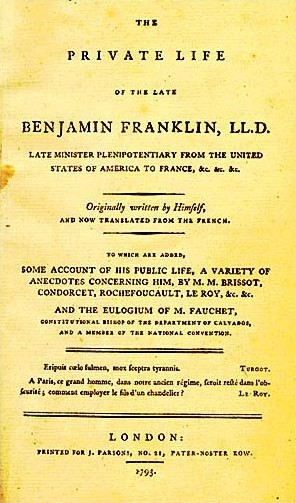
However, in 1793, William’s illusions that he had thwarted an English translation of the French edition ceased when two editions came out. One was published by J. Parsons in London and was a very literal translation of the French (Labaree et al. 28). The other translation of the French came out in installments in The Lady’s Magazine or Entertaining Companion of the Fair Sex, which was a British magazine sold from 1770 until 1837, costing six pence per issue (regencyfashion.org).

The same publishers of this British Fashion Magazine also published the two-volume work, Works of the Late Doctor Benjamin Franklin: Consisting of His Life Written by Himself, together with Essays, Humorous, Moral &Literary, Chiefly in the Manner of the Spectator (Labaree et al. 29). A translation of Franklin’s autobiography made up the first 94 pages of this book, followed by excerpts from Franklin’s will, letters Franklin had written, and various essays, including “On Modern Innovations in the English Language and in Printing” and “On the Art of Swimming” (archive.org). Benjamin Vaughan largely took responsibility for the publication of this text (Labaree et al. 29). Because we know that the autobiographical section of the work is a translation of the French, we can assume that Vaughan had by this point lost the copy that Benjamin Franklin had originally sent to him. Responding to William Temple Franklin’s probable anger over the publication of this work, the Preface states, “There can be no sufficient reason, that what has thus been submitted to the perusal of Europe, should not be made accessible to those whom Dr. Franklin’s language is native” (Labaree et al. 29). Over the next several decades this work was translated into Danish, Dutch, French, German, Polish, and Spanish across the world and became the primary source for the works of Benjamin Franklin during the era, while William Temple Franklin inexplicably sat on his manuscript without publishing it (Labaree et al. 30).
Finally in 1817-1818, William began publishing the full text that he possessed, although still not realizing that he did not have the text in its entirety that he had traded to Le Veillard (Labaree et al. 31). Along with texts containing Franklin’s Private Correspondence and political writings, Temple published all the parts of the Autobiography that he had in a five-part volume. This edition of the text was considered the complete edition until the real edition became available in 1867 and people began to notice multiple discrepancies (Labaree et al. 31). Today there is much debate over who changed (and why) so many things from the original. Some of the changes may have been a simple result of multiple translations from English to French and back to English, but other changes seem like deliberate efforts to clean up Franklin’s writing (Labaree et al. 33).
Louis Le Veillard, the man to whom William Temple Franklin had sold the original text, began carefully translating the original and seemed to want to publish it, but he was executed during the Reign of Terror before he got the chance (Labaree et al. 34). After the original manuscript had floated around Europe for several decades, the Library of Congress bought it from a bookseller in Europe in 1908. In the meantime, an American minister named John Bigelow had owned the original manuscript along with Franklin’s original outline, and in 1868 Bigelow published the first edition of the work to be actually based on the original manuscript (Labaree et al. 35). However, there were still a few errors that were fixed in the 1940’s edition.
The chaotic story of the writing and publishing of this work demonstrates how much interest there was in keeping the autobiography of Benjamin Franklin alive. Like the strange and rapidly changing life of the man who wrote this work, the production of it for posterity was similarly hectic, but with a fruitful result. Today, the work has become one of the most influential pieces of autobiography in history, giving us a glimpse into the mind and life of a man who had so much influence on our nation, our knowledge, and our beliefs.
Works Cited: Franklin, Benjamin. The Autobiography of Benjamin Franklin. 2nd ed. New Haven: Yale University Press, 2003.
Labaree, Leonard W. et al. Introduction. The Autobiography of Benjamin Franklin. By Benjamin Franklin. 2nd ed. New Haven: Yale University Press, 2003.
"The Franklin Trail." Benjamin Franklin House. Benjamin Franklin House, n.d. Web. 10 Dec 2011. .
Price, Richard. The Correspondence of Richard Price. 3. Duke University Press, 1994. eBook. .
Bouchard, Jen. "Paris's 16th Arrondissement." Europe Up Close. Europe Up Close, n.d. Web. 10 Dec 2011. .
"Benjamin Franklin: Writer and Printer." Library Company. N.p., n.d. Web. 10 Dec 2011. .
"Publisher: Chez Buisson." Open Library. N.p., n.d. Web. 10 Dec 2011. .
"The Lad'ys Magazine." Regency Fashion. N.p., n.d. Web. 10 Dec 2011. .
"The Works of the Late Doctor Benjamin Franklin." Internet Archive. N.p., n.d. Web. 10 Dec 2011. .